


01 — Back Where It Belongs
There are certain names in motorsport that carry a weight beyond trophies and lap records. McLaren is one of them. From the rocket-fuelled dominance of Can-Am in the late 1960s to that unforgettable, maiden victory at the 24 Hours of Le Mans in 1995, the Woking marque has always occupied a space at the very summit of racing. And now, after nearly three decades away from the top class of endurance competition, McLaren is back.
In 2027, the McLaren Hypercar Team will make its long-awaited debut in the FIA World Endurance Championship’s Hypercar class, fielding a pair of its brand-new prototype racers at circuits and endurance events around the globe. The announcement sent shockwaves through the motorsport world — and with very good reason.
“Taking the McLaren name back to the pinnacle of sportscar racing is a huge milestone. It’s a proud time for everyone within McLaren Racing and McLaren Automotive.” — James Barclay, Executive Director, McLaren Endurance Racing
This isn’t just a nostalgia project. It’s a fully funded, deeply engineered programme built to compete — and to win.
02 — The FIA World Endurance Championship
If Formula 1 is the pinnacle of single-seater racing, then the FIA World Endurance Championship is its equivalent in the world of sportscar competition. The WEC is a global series of long-distance races contested across multiple continents, with each round lasting anywhere from six hours to a full day-and-night marathon.
At its peak sits the Hypercar class — a category that has drawn some of the most iconic automotive names in the world in recent years, including Ferrari, Toyota, Porsche, BMW, Cadillac, Aston Martin, and Alpine. These aren’t road cars with cages welded in; they are full-fat, purpose-built prototype racers, constrained by a strict technical framework designed to keep competition fierce and financially sustainable.
The jewel in the WEC’s crown is the 24 Hours of Le Mans — the most famous endurance race on earth, held on the legendary Circuit de la Sarthe in France. Winning Le Mans is not just a motorsport achievement; it is a cultural milestone. And it is precisely this race that lies at the heart of McLaren’s return.
The current era of the WEC is widely regarded as a golden age for sportscar racing. The Hypercar class offers genuine multi-manufacturer competition at the highest technical level — and McLaren has chosen this exact moment to make its move.
03 — Meet the MCL-HY
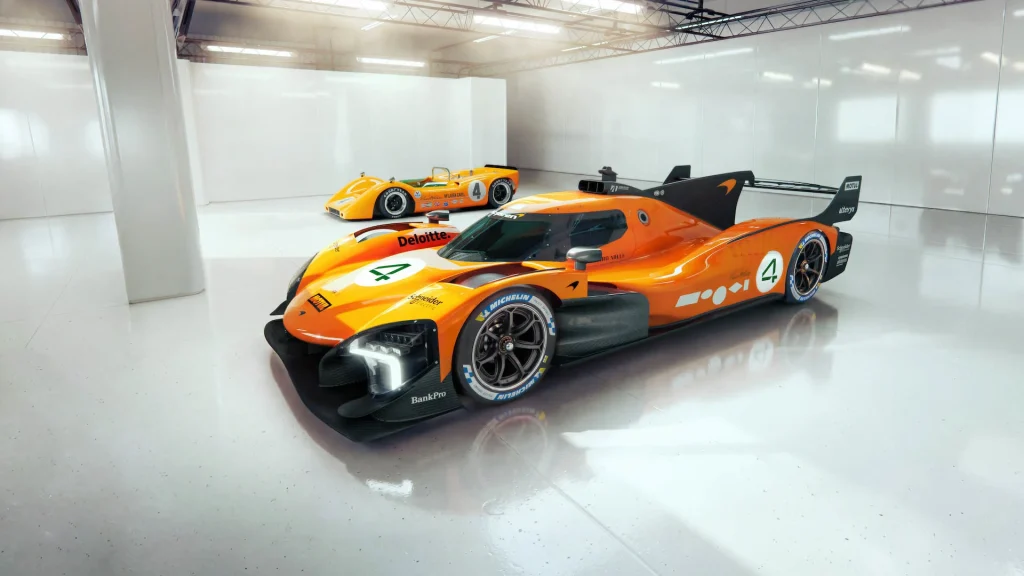
The car itself is called the MCL-HY. In typical McLaren fashion, the naming is deliberate and purposeful — the ‘MCL’ prefix mirrors the team’s Formula 1 naming convention, while ‘HY’ denotes the Hypercar designation. It’s a statement of unified identity across the very highest echelons of world motorsport.
Built to the ACO/IMSA LMDh regulations, the MCL-HY is a hybrid prototype. At its heart is a purpose-built, twin-turbocharged V6 racing engine paired with a hybrid MGU (Motor Generator Unit) system. Together, they deliver up to 520kW — approximately 697 brake horsepower — to the rear axle. The carbon fibre monocoque chassis keeps the minimum weight down to 1,030kg, giving the car a performance-to-weight ratio sharply tuned for endurance-pace efficiency as much as outright speed.
Key specifications:
- Engine: Twin-turbocharged V6 + Hybrid MGU system
- Peak power: 520kW (697bhp) to the rear axle
- Minimum weight: 1,030kg
- Chassis: Carbon fibre monocoque
- Drive configuration: Rear-wheel drive
- WEC entries: Two full-season cars
The MCL-HY was first shown to the public in concept form at the 2025 Le Mans 24 Hours fan village. Since then, the aerodynamics have been significantly revised and refined, with the car’s final form revealed in full during May 2026. When it rolled out wearing its 2026 test livery — a striking design inspired by the iconic McLaren M6A Can-Am racer of the 1960s — it was clear this was no mere show car. This was a racing machine.
That test livery carries its own beautiful symbolism. The M6A was the car that Bruce McLaren himself once dreamed of racing at Le Mans. He never got the chance. In 2027, his name will finally take to La Sarthe’s fabled asphalt in the full force of competition.
04 — Testing: Building Towards Glory
McLaren knows better than most that turning up to Le Mans unprepared is not an option. The team launched its on-track testing programme in May 2026, committing the full remainder of the year to intensive development ahead of a planned homologation in winter 2026–2027.
It is a rigorous and methodical campaign. The test programme simultaneously supports development of both the race car and its track-only sibling, the MCL-HY GTR, meaning data gathered on circuit informs both projects in real time. Nothing is being left to chance.
Leading the charge is works driver Mikkel Jensen, the Danish racer who spent four years with Peugeot’s hypercar project and brings deep LMDh knowledge to the MCL-HY’s formative miles. Alongside him, McLaren Driver Development Programme drivers Grégoire Saucy and Richard Verschoor are contributing development laps, while Ben Hanley of United Autosports adds valuable benchmark experience to the programme.
On the race driver front, Laurens Vanthoor has been confirmed for the 2027 season. The Belgian ace arrives after a stint with Porsche Penske Motorsport where he claimed three WEC victories, and has made no secret of his all-consuming desire to win Le Mans outright. Paired with Jensen’s technical intelligence and Hypercar-specific know-how, McLaren has a lineup capable of standing on any podium in the world.
The goal is crystal clear: arrive at the first round of the 2027 WEC season with a fully homologated, fully race-ready machine that can compete for victory from the very first lap.
05 — The Triple Crown Dream
Here is where McLaren’s 2027 WEC programme becomes truly extraordinary. The team’s entry into the Hypercar class doesn’t exist in isolation — it is the final, critical piece in the pursuit of motorsport’s most coveted and most elusive achievement.
The Triple Crown of Motorsport encompasses three victories: the Monaco Grand Prix, the Indianapolis 500, and the 24 Hours of Le Mans. McLaren is now the only team on earth simultaneously competing at the very top of all three series — Formula 1, the NTT IndyCar Series, and the FIA WEC.
“McLaren Racing now has three race cars competing across Formula 1, INDYCAR and WEC. This allows McLaren, its partners and its fans to pursue the Triple Crown of the Monaco Grand Prix, the Indianapolis 500 and the 24 Hours of Le Mans together — a unique cross-series story that sets us apart.” — Zak Brown, CEO, McLaren Racing
No manufacturer has ever won all three in the modern era. With the MCL-HY completing the trifecta of McLaren’s competitive footprint, the Woking marque is uniquely positioned to make that historic achievement a reality.
06 — The Season Ahead: Dare to Dream
The 2027 FIA World Endurance Championship season promises to be one of the greatest in the series’ history. McLaren will be stepping onto a grid populated by Ferrari, Toyota, BMW, Alpine, Cadillac, Aston Martin, and more — a murderers’ row of automotive giants who have been honing their Hypercar programmes for years.
It would be naive to expect McLaren to arrive and immediately dominate. The learning curve in WEC is steep, the tyre management demands are brutal, and the racing is relentless over stints that dwarf anything found in Formula 1. But this is a team that swept to the Constructor’s Championship in F1. This is a brand that won Le Mans on its very first attempt. Naivety works both ways.
The MCL-HY itself has been engineered not just to survive a 24-hour race, but to thrive in one. The hybrid powertrain, the aerodynamic balance, the carbon monocoque — every decision has been made with Le Mans Sunday morning in mind.
When the 2027 WEC season begins, the papaya and carbon of the MCL-HY will line up alongside the titans of endurance racing. For McLaren fans, for endurance racing fans, and for every motorhead who ever watched the lights go out at Le Mans with their heart in their mouth — this is the beginning of something extraordinary.
Welcome back, McLaren. The track has missed you.
Comments are closed